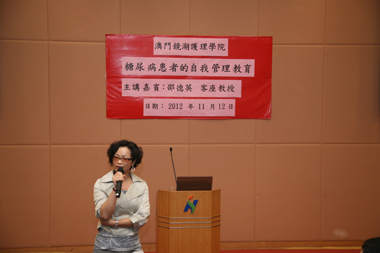
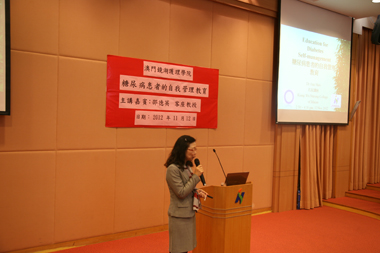
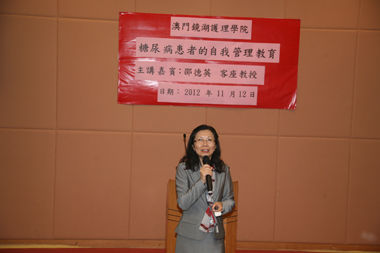
Professor Shiu Tak Ying Gives Lecture on Empowerment Model for Diabetes
To enhance the academic ambience of the College, widen students’ horizons, and be consistent with the theme of the celebratory activities of the 90th College anniversary “Carry on with loving care inherited from KWNC over the past 90 years; Together we build a better future to head for its centenary”, the second Distinguished Lecture “Education for Diabetes Self-management” was held on the afternoon of 12 November at Lecture Theatre I. Professor Shiu Tak Ying, Advisor of the Association of Hong Kong Diabetes Nurses Limited and Guest Professor of KWNC, was invited to be the speaker. The lecture was hosted by Associate Professor Hu Xiaoxia and an attendance of nearly 100 College teachers and students, and Kiang Wu Hospital nurses was registered.
Professor Shiu is a former Associate Professor of the Nethersole School of Nursing of the Chinese University of Hong Kong (CUHK), and is now teaching general education courses in the Chung Chi College of CUHK. Professor Shiu has been working for nursing education for years and her major research expertise lies in diabetes care and education. She was awarded the Teacher of the Year Award by the Faculty of Medicine of CUHK in Year 2000. Professor Shiu is currently appointed as the Honorary Advanced Practice Nurse by the Hong Kong Hospital Authority and is now serving as the Co-opted Member of the Education Committee of the Nursing Council of Hong Kong.
In the lecture, Professor Shiu indicates that there is a continuous increase in the number of diabetes patients and new cases in the recent years. In Hong Kong, there is one diabetes patient among every 10 residents and the patients are becoming younger. In view of this, to promote the education of self-management to diabetes patients is exceptionally important for easing the growingly severe problem of diabetes. Diabetes is a type of chronic disease very much related to one’s lifestyle. Unhealthy dietary habits, obesity and insufficient exercises are some of the major factors leading to the disease. As a result, the management of the disease does not simply rely on the medical standards or medicine dosage, but also on the self-management of the patients. Professor Shiu summarizes four types of self-efficacy that diabetes patients have to possess, including medical knowledge on diabetes, life skills to negotiate care, ability to adapt to role changes and ability to manage negative emotions. In addition to the above internal efficacy, Professor Shiu adds that the support and motivation given by family and health professionals are also crucial for the self-management of patients.
To facilitate an effective self-management, Professor Shiu introduces a model that is appropriate to tackle chronic diseases and its name is “empowerment model”. “Empower” means to assist patients in enhancing their innate ability to manage the disease and encourage them to be the main carer of their health. Therefore, compared with the traditional model, “empowerment model” is more appropriate for guiding the education of diabetes self-management. To implement the “empowerment model”, health professionals should serve as facilitators to encourage diabetes patients to take the initiative to express their thoughts and difficulties about managing the disease, listen to their needs patiently, and care about their situations from the psychosocial aspect. Moreover, a two-way communication should be built by means of role play, modelling, group discussion and one-to-one counselling, etc. through which the health professionals and patients work together to discuss the achievable ways of managing the disease.
The lecture given by Professor Shiu stimulated the participants to think about the self-management education for diabetes patients, and enabled them to gain an understanding on the new model of managing chronic diseases. After listening to the lecture, many participants raised questions and expressed their own opinions. Professor Shiu answered participants’ questions and presented some more knowledge and research findings about diabetes, and shared her own experience of communicating with patients. All participants felt that they had benefited a lot by attending the lecture. Coinciding with the World Diabetes Day on 14 November and observing the similar situation of the growing number of diabetes cases and young patients that Macao is experiencing, this lecture demonstrated special significance in arousing the attention of the College teachers, students and nursing peers on diabetes prevention and management.