KWNC Promotes Life and Death Education
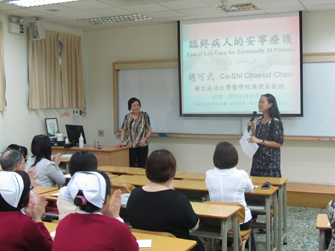
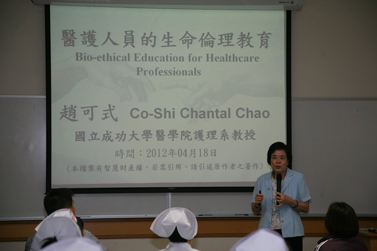
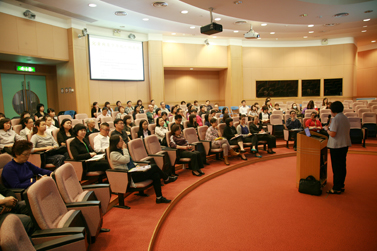
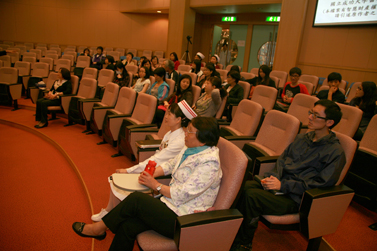
Birth, age, sickness and death are the stages that people surely go through, and death is inevitable in the course of life. Life and death education and end-of-life care are important subjects for health professionals. Only when the professionals clearly recognize the fact and meaning of death and end of life, can they be capable of taking care of the suffering patients and the patients' family members. Since nursing professionals are often in contact with terminally ill patients, their personal attitudes towards death directly affect the quality of nursing. In order to allow nursing professionals to be more familiar with life and death education and end-of-life care, Kiang Wu Nursing College of Macau (KWNC) has invited Professor Co-Shi Chantal Chao, Mother of Hospice Care of Taiwan and renowned scholar from the Department of Nursing of National Cheng Kung University of Taiwan, to deliver and host a number of lectures and workshops during 16 to 20 April 2012. A total of more than 300 participants have attended the lectures and workshops, including doctors, nurses, nursing teachers and students, secondary school teachers, counsellors, patients and their family members.
The World Health Organization defines hospice care as the overall supportive care for terminally ill patients on whom the curable treatments no longer work in an effective and beneficial way. Hospice care offers patients pain control and alleviation for other symptoms, and provides psychological, social and spiritual care to enhance the quality of life of both the patients and their family members. Professor Chao has been promoting hospice care for over 30 years and has accompanied a considerable number of patients to complete their last stage of life. She uses “sheng sheng shi shi” (homophonic with “three three four four” in Chinese) to summarize her understanding about hospice care. The two “three” refers to “comfortable end of life for terminally ill patients, endurable separation for bereaved family members, nice life for those who live; and physical, mental and spiritual safety”; and the two “four” refers to “care for the whole person, whole journey, whole family and the whole team” and “gratitude, apology, conveyance of love and farewell”. Professor Chao particularly pays attention to helping terminally ill patients and family members with the second “four”.
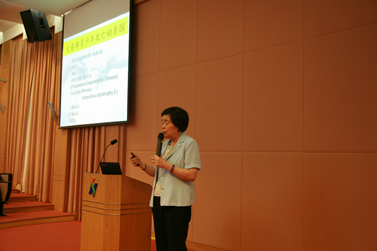
Professor Chao quotes the evidence of scientific researches and shares her experience and some cases about taking care of terminally ill patients. She illustrates that the intubations, body openings and body reaction towards excessive injections are resulted from “excessive treatment” and “ineffective treatment” which in turn cause more sufferings for the patients and form a violent “torture of end of life”. She also borrows some real cases to discuss the ethical issues with nursing teachers and nurses, including ethical reasoning and choice, and whether to carry out first aids for the patients. Professor Chao encourages nursing teachers not to detach themselves from clinical practice and patients, to increase their care for the patients and improve their teaching and research capability. She expresses that terminally ill patients should receive respect and care in their remaining days and quality of life is actually more important than the length of life. During their end of life, patients suffer a lot both physically and mentally. They require care and attention of even higher quality so as to alleviate the pain and expect a more comfortable end of life. To provide terminally ill patients with high quality and the most ideal whole-person physical and mental care is indeed a better way to conform to the ethics of the profession , and hospice care can offer patients and family members a more comprehensive and supportive care.
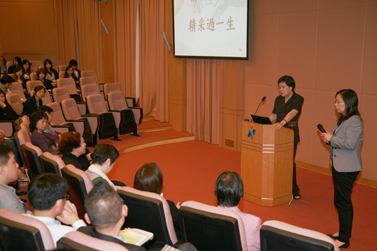
The Chinese society always avoids discussing about death. Many adults purposely avoid talking about death with their children, oppressing children's exploration about life and death, and therefore often results in misinterpretation of the children. Under the support of the Chinese Educators' Association of Macau, KWNC organizes a special lecture “School Teachers' Thanatology and Sadness Counselling” for secondary school teachers and counsellors. Professor Chao uses examples to point out the factors influencing children and teenagers' understanding towards death. She also explains how the Chinese culture creates unfavourable condition for children and teenagers to develop a mature view about death, and clarifies that it is incorrect to think that children don't understand death. Professor Chao emphasizes that life and death education should be initiated at the time when children are young; and parents, school teachers and professionals play important roles in educating them . Children's attitude towards life depends on their education. Life and death education allows children to think about the complicated issues about death, and learn to face death with an open and healthy attitude. During the lecture, Professor Chao uses some clinical cases and stories to demonstrate how to handle children and teenagers' sad feeling. In addition, Professor Chao discusses with the audience about the key points of counselling school students in the incidents of bereavement and suicide.
Professor Chao's active promotion of hospice care facilitate d the legislation of “Statute for Palliative Care” in Taiwan. In this lecture series, she shares her rich clinical and teaching experience s and demonstrates life and death education from the perspectives of medical science, psychology, sociology, end-of-life care and philosophy of religion in a specific, vivid and meticulous way. Moreover, Professor Chao raises many reflective issues that evoke audience to think deeply about life and death education and end-of-life care. By holding the lectures and workshops, KWNC hopes to reinforce nursing professionals' knowledge about life and death education and end-of-life care, promote a positive perception about death for the general public, and allow them to better reali s e the importance of cherishing their life through gaining more knowledge about death.