UK Specialist Speaks on Evidence-based Nursing
“Evidence-based” is the most important mode of practice in medical circles nowadays while evidence-based nursing has turned out to be a foundation stone for heading to more professionalized nursing care of the time. In order to strengthen the knowledge of evidence-based nursing among the local nursing professionals and student nurses, to learn from overseas experiences involving evidence-based nursing development, a seminar on the topic of “Evidence-based nursing in UK” was organized by Kiang Wu Nursing College of Macau on Nov. 4th, 2010, at which, Dr. Graeme D. Smith from Edinburgh University was invited to give a speech. The seminar, which was open to the general nursing workers in Macau, recorded an attendance of over 150 people, including nursing teachers, student nurses from KWNC and IPM and clinical nurses.
At his talk, Dr. Graeme D. Smith gave an idea about the roles that literature review and systematic literature review play in evidence-based nursing. He pointed out that systematic review has become evidence resources of the most credibility in current professional and academic circles. By recommending a few reference websites offering a systematic literature review, Dr. Smith said that it could save time and energy previously needed during the traditional literature review while enhancing efficiency and accuracy of review if the approach of systematic review is used. Then he shared his own experience with the participants in terms of systematic review, and he provided assessment tools for the examination of the reliability of evidence materials. Dr. Smith indicated that nursing work itself is based on practice, even since Florence Nightingale’s period of time when she got her nursing work instructed by certain evidence. Nursing care of a nurse has to rest on something, otherwise it will possibly bring risks and dangers to the care-receivers. Therefore, evidence-based nursing is not a “new” advocacy, yet evidence materials for reference provide the latest information to learn in conformity with the professional and academic development.
The talk received enthusiastic response from participants at the end when lots of questions were raised to the speaker. In his answers Dr. Smith expressed that overseas countries are also facing the problems of nurse shortage and heavy nursing workloads. One may get it started with the working approach whenever evidence-based nursing is to be pushed forward during busy clinical work; as professionals, nurses have to make evidence-based nursing a concept of internalization and practice habit. This is also a key concern for effective communication between nurses and collaborative medical team and for individual professional development. The seminar came to a successful end in warm applause.
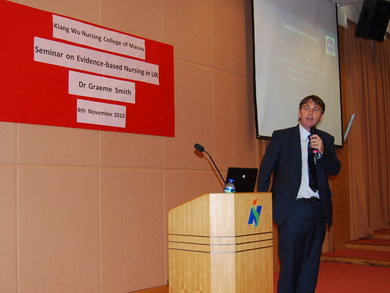
Dr. Graeme D. Smith
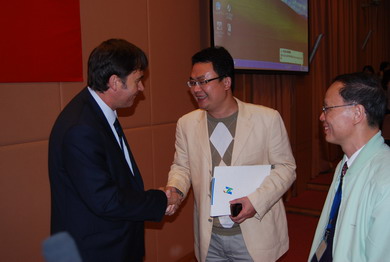
Dr. Smith and teachers exchanging information
on evidence-
based nursing in two areas