Lecture on issue of Health-Related Services
To enhance awareness of the medical environments in inland China and Hong Kong, and understanding of the latest nursing development trend worldwide among students, a lecture on the issue of health-related services was organized by Kiang Wu Nursing College of Macau on Sept. 25th, 2010. The Cluster Chief Executive, Dr. Cheung Wai-lun from Hospital Authority Hong Kong and Dean of School of Nursing Peking Union Medical College, Prof. Huaping Liu were invited as speakers. The attendees of guests, clinical nurses, KWNC faculty and students totalled 200 and more.
Dr. Cheung and Prof. Liu respectively put forward the issue that inland China and Hong Kong both are facing the problems of population aging, change of epidemic diseases and growth of chronic disease prevalence rate. As for Macau, with a 7.7% of aged people over 65 among the permanent population by end of 2009, comparing to the 8.5% recorded in mainland and 12.9% in Hong Kong, its aging situation should not be neglected. The aging problem will increase medical needs. According to HA statistics in 2007, the age structure of inpatient service users are shown in V shape with age 5 to 14 as the lowest layer and an average of 50 users among 1000 people. Inpatient users over 65 are increasing by times. Moreover, the first three causes of death in Hong Kong and Macau are all chronic diseases, the first of which is cancer that makes another major factor for medical service demands, against which, nurse demand is accordingly rising. However the three areas of inland, Hong Kong and Macau have all been facing a crucial shortage of nurse manpower and flow-away problem.
To improve the current supply and demand situation, Dr. Cheung suggested that improvement of nurses’ promotion prospects and working condition as well as enhancement of vocational training for nurses should be needed. Meanwhile, relevant policies are needed to set up in support of nurses from different levels so that they can give full play to their professional roles and functions. Prof. Liu recommended an adjustment to the nurse education structure, building up appropriate legal systems for specialty nurses’ development; putting stress on specialist nursing development areas and forming nurse teams for geriatric nursing and community nursing services so as to tackle with the current challenges.
To meet the challenge arising from the current medical environment, Dr. Cheung proposed that enhancement of the quality in medical and nursing services may tackle the problem. The core competencies of Nursing Service Quality are knowledge, skill and attitude which may be imparted by teachers through education. However the attitude of nursing workers is always influenced by working condition. They should learn to experience different clinical situation by themselves and learn from the fine examples of senior generations to form professional attitude of nurses. In Hong Kong, the traditional doctor-oriented notion in medical institutions about nurses being marginalized has been changing. Nurses nowadays play important roles in collaboration with clients, their families, the medical teams and other individuals on assessment, planning and implementation of patient care.
In terms of nurses in inland China, Prof. Liu pointed out that thanks to the policy support, the education level has been upgraded, from nearly one half of nurses being graduated from technical secondary school to a more multilevel education structure of secondary-junior college-undergraduate combination. She emphasized that the examination system for nurse practitioner serves as a threshold in mastery of professional service skills and a significant mechanism to ensure social safety and medical quality, especially under the current rapid developing medical situation. The national unified Nurses Registration Ordinance was enforced in 2008 over China, which help enhance the nurses’ integrated level and professional position by standardized practitioner qualification, right and obligation.
At present, the education level of nurses in Macau is rising, with more than 60% of nurses in service holding baccalaureate degree. The Macau government may also consider a unified system to govern practitioners’ professional qualification and to reinforce the competencies and working power of nursing team so as to meet social needs. Meanwhile, we can refer to Hong Kong's experience that nursing workers should be divided by professional responsibilities so that specialty nursing can be developed to meet patient needs at different stage of treatment.
During lectures, the specialists gave detailed answers to all the questions actively raised by the faculty and students. To sum up, KWNC Lecturer Milly Ug finally made a conclusion that the two nursing institutions has continually open up specialist postgraduate programmes for recent years. Graduates for the first session were born this year that lay the foundation for supply of specialty nursing workers for different care services. Currently, the most urgent matter is to stipulate and put into practice every role function and nursing criteria of specialty nurses; optimize the relevant legislation of specialty nurses; improve their professional career to get systematic specialty nursing services for Macau residents. The lecture came to a successful end amid warm applause.
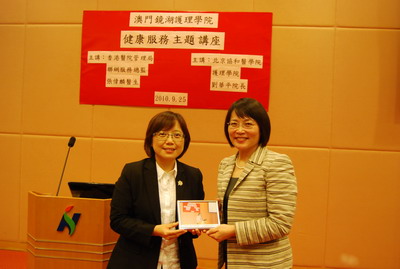
President Van presenting Souvenir to Prof. Liu
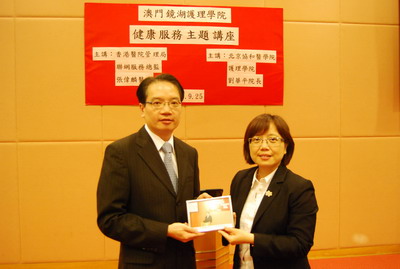
President Van presenting Souvenir to Dr. Cheung